
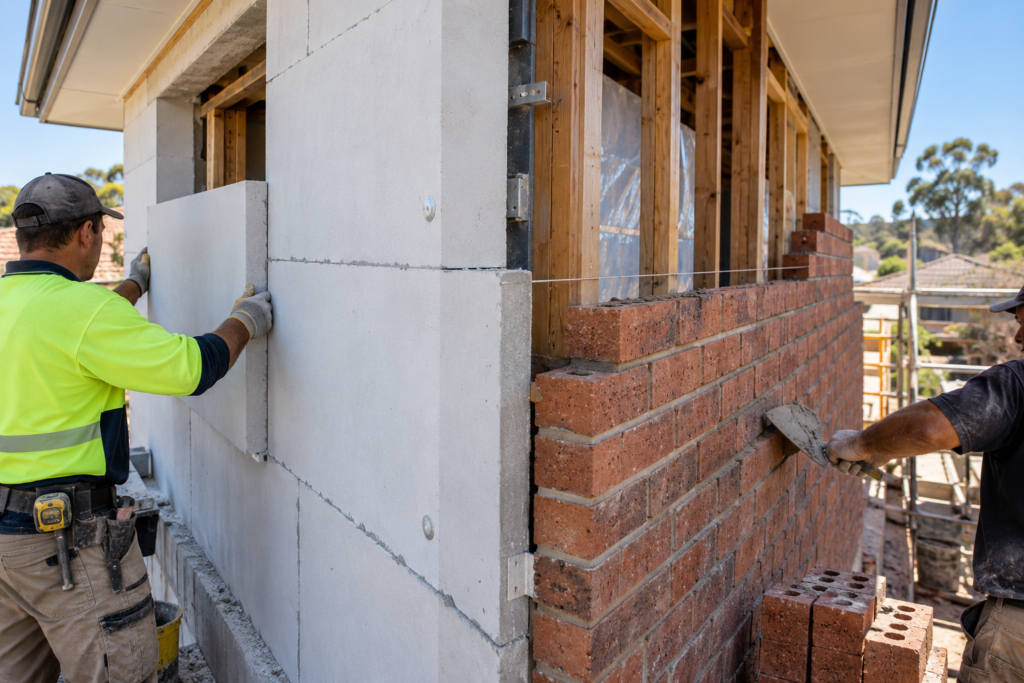
If you’re specifying a new custom home or knockdown rebuild in Sydney, “Hebel or brick?” is a question that comes up early, usually from your designer or builder rather than something you arrived at searching yourself. Here’s what actually separates the two, based on NSW planning rules, the manufacturer’s own technical documentation, and genuine accounts from people who’ve lived in both.
What Hebel Actually Is
Hebel is the brand name CSR uses for autoclaved aerated concrete (AAC), sold in Australia as PowerPanel and PowerPanelXL for walls, PowerFloor for flooring, and PowerBlock for load-bearing block walls. It’s a lightweight concrete product, manufactured as panels or blocks rather than laid brick by brick, and it’s recognised by name in NSW’s own BASIX thermal performance rules as a distinct wall construction type, alongside brick veneer and cavity brick.
Weight Is the One Clear, Undisputed Difference
CSR’s own figures put Hebel panels at up to a third of the weight of brick for the same wall area. That’s the one comparison point that isn’t marketing spin, it’s a straightforward consequence of how aerated concrete is made, and it’s why Hebel shows up so often on upper-storey walls, extensions over existing structures, and sites where reducing structural load genuinely matters.
Thermal Performance: Real, But the Exact Numbers Are Murky
NSW’s Planning Portal states plainly that because AAC is aerated, it has “a higher inherent insulation (R-value) than some other wall or floor systems,” and depending on the panel thickness and your site’s climate zone, BASIX may not require you to add further insulation on top of it. That’s a genuine, government-stated advantage, not a sales pitch.
Where it gets murkier is the specific multiplier. CSR’s own marketing material claims Hebel offers anywhere from roughly two to three times the thermal resistance of standard brick, depending on which CSR-affiliated source you read. Those two figures don’t agree with each other, which tells you they’re marketing comparisons rather than a single independently tested result. Treat “Hebel is dramatically warmer than brick” as a real but imprecisely quantified advantage, not a number to take at face value.
Fire Resistance and BAL Ratings
If your block is bushfire-prone, this matters. CSR markets its Hebel products as meeting or exceeding all six Bushfire Attack Level categories defined under AS 3959, from BAL-12.5 up to BAL-FZ (flame zone, the highest rating, where direct flame contact is a real risk). That’s the manufacturer’s claim. What you actually need before relying on it is the current CodeMark certificate for the specific Hebel product and BAL rating your site requires, confirmed against your own BAL assessment, not a general brand reputation. If you’ve read our guide to building on bushfire-prone land, this is exactly the kind of site-specific verification that applies here too.
Acoustic Performance: Where the Marketing and Real Experience Disagree
CSR publishes acoustic ratings for Hebel wall systems (Rw+Ctr figures in the low-to-mid 30s for standard panels, higher for full block-wall systems), and the material is often marketed as a quieter option than brick. We couldn’t find a published, equivalent acoustic rating for standard brick veneer to actually compare it against, which is itself telling. More useful: a homeowner who’d lived in a Hebel-and-render home for two years reported, in their own words, that it performed worse for sound insulation than brick veneer, and that they’d have installed double glazing if building again. That’s one person’s real experience, not a lab result, but it’s a genuine data point the glossy brochures don’t mention.
What People Who’ve Actually Lived With It Say
Away from manufacturer brochures, a few things come up consistently in builder forums and real homeowner accounts:
Fixings need planning. You can’t screw something heavy, like a washing line bracket or roller shutter, straight into a Hebel panel the way you might into brick. It needs to land on a timber stud or nogging underneath. One account described roller shutters tearing away from a two-month-old Hebel wall in a storm, because they’d been bolted straight into the panel rather than into the framing behind it; the builder covered the repair.
Joints need proper detailing. CSR’s own technical manual is upfront that cracking can occur from foundation movement, adjacent material deformation, or workmanship, which is exactly why movement and control joints are specified in the system. A building inspection checklist we reviewed documented real-world examples: cracked vertical joints between panels, and cracked horizontal joints where panels meet the slab, in some cases letting water into the building. This isn’t unique to Hebel, every material has installation failure modes, but it underlines that Hebel is less forgiving of rushed or inexperienced installation than render-over-brick.
Rendered surfaces show dirt and don’t love pressure washing. Multiple accounts flagged that rendered Hebel walls mark easily and that high-pressure cleaning can damage the surface. If low-maintenance walls matter to you, this is worth asking your builder about directly.
Cost: Less Straightforward Than Either Side Claims
We couldn’t find a solid, current, Sydney-specific cost-per-square-metre figure comparing Hebel to brick, and we’re not going to invent one. One volume builder’s case study claimed a Hebel facade saved around $25,000 compared to a fully rendered brick equivalent, but that figure is tied to one specific house design, not a general rule. As a rough anchor point, brick veneer construction in Australia tends to run somewhere in the $1,750 to $2,800+ per square metre range depending on finish and location, with full double brick typically 20 to 35% above that. Where Hebel genuinely tends to save money is in render and labour, since one Hebel panel covers roughly the same wall area as 75 traditional bricks, which can mean faster, simpler installation on the right project. The honest answer is that your real cost comparison depends on your specific design, site, and finish, and the only number worth trusting is a quote on your actual plans.
What This Means for Your Build
Neither material is simply “better.” Hebel’s genuine strengths are real: lighter weight, a government-recognised thermal advantage under BASIX, and faster coverage per panel. Brick’s long track record, predictable fixing and maintenance behaviour, and well-understood acoustic performance are real too. The right choice depends on your site’s structural needs, your climate zone and BASIX obligations, whether you’re building on a bushfire-prone block, and how much you value low-maintenance finishes versus thermal performance. A builder who can talk you through the actual trade-offs for your specific site, rather than defaulting to whichever material they’re more used to working with, is worth more than either material’s marketing.
Frequently Asked Questions
Is Hebel cheaper than brick?
It depends on the project. Hebel can save on render and labour costs since one panel covers roughly the equivalent of 75 bricks, but there’s no reliable general per-square-metre figure proving it’s cheaper overall. Get a quote on your actual design for a real answer.
Is Hebel as fire-resistant as brick?
CSR markets Hebel products as meeting all six Bushfire Attack Level categories under AS 3959, but this needs to be confirmed against the current CodeMark certificate for your specific product and BAL rating, not assumed from general brand reputation.
Does NSW’s BASIX standard treat Hebel differently to brick?
Yes, in one specific way: BASIX recognises AAC as its own distinct wall category, and depending on panel thickness and your climate zone, it may waive the requirement for additional insulation that a comparable brick veneer wall would need.
Is Hebel quieter than brick?
Not necessarily. While Hebel is marketed on acoustic performance, we found no directly comparable published rating for brick veneer, and at least one real homeowner reported Hebel performed worse for sound insulation in their own home.
What’s the biggest practical downside of Hebel?
Fixings and joint detailing need more care than brick. Heavy items need to be fixed into the timber framing behind the panel, not the panel itself, and movement joints need to be installed correctly to avoid cracking.
If you’re weighing up materials for a new build or rebuild and want a team that will talk through what actually suits your site rather than a one-size-fits-all answer, our guide to BASIX requirements and the 7-star thermal standard covers the compliance side of the decision in more depth.