
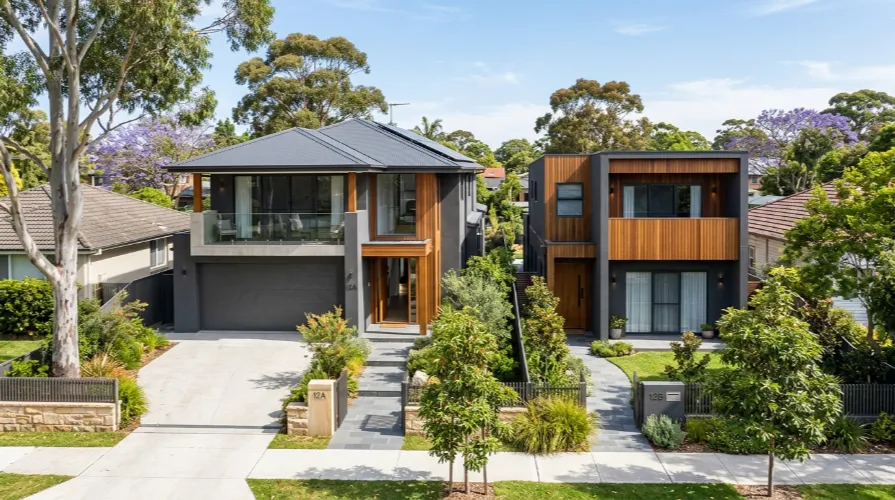
Are you looking to maximise the earning potential of your property but find yourself stuck between a dual occupancy vs. a duplex in Sydney? Understanding and navigating New South Wales planning policies can feel like a foreign language, and your capital is not working. Property investors regularly battle to know which option would yield the greatest profit, leaving behind thousands of dollars in equity. With this guide, you will learn what the law says, the subdivision rules and the actual rental yield differences without the council speak.
Jason Smith, a top home builder in Sydney, has over 15 years in the building industry. He specialises in maximising your property value with dual-living builds. Throughout his career, he has guided hundreds of clients through complex municipal development processes.
What Is a Dual Occupancy in Sydney?
If you know the legal framework applicable to your build, you will avoid expensive delays by the council or by the principal certifying authority (PCA). Many owners mistake multi-dwelling consents for simple seconds.
‘Dual occupancy’ refers to having two homes on one lot. It legally operates under a single title property. This arrangement is ideal for families who like multi-generation living or long-term property investors. Landowners apply this tactic as a shortcut to the subdivision performance standards while unlocking two income sources.
A dual occupancy attached facility has a wall, floor or ceiling slice in common On the other hand, a separate dual occupancy consists of two buildings on one site. Typically, it is arranged as a primary house with a granny flat or a secondary dwelling. A detailed breakdown of costs for these layouts can be provided; however, you can get an initial pricing plan for multi-dwelling builds to help form the development budget baseline.
The main limitation of a standard dual occupancy vs duplex sydney when comparing dual living vs duplexes is the ownership structure. Since both houses are on one title, you can’t sell one house to a third party. You have to sell the entire property as a package, or you must hold both units to get rent cheques at the same time.
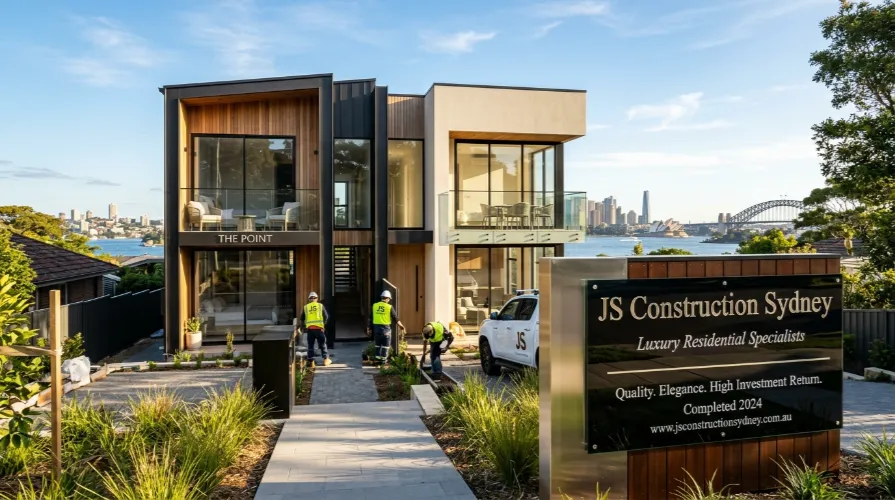
What Is a Duplex and How Does It Differ?
Although a duplex appears the same as an attached dual occupancy vs duplex sydney to the street, their legal and financial structures differ.
A duplex is a single lot that has two living units attached to each other. The owners can have the land subdivided into two titles. This approach is typically used to gain equity and sell properties in rapid succession. Investors create duplexes so that they can have a flexible exit.
A legal right to subdivision is an absolute game-changer for a duplex investment. Generally, a Torrens Title or a Strata Title split is a subdivision. Once your council or private certifier approves your subdivision, the one lot will legally become two lots.
You can occupy one half of the property while selling the other and erase your mortgage entirely. Another option is to sell the two units separately so that you can quickly realise capital gains. This capacity for flexibility makes the duplex an exceedingly appealing choice for predatory developers looking to rapidly expand their portfolios. Teaming up with an expert residential construction company in Sydney will make sure your site design meets all safety, council and engineering benchmarks.
Dual Living vs Duplex: Head-to-Head Comparison
If you employ the wrong strategy you can freeze your capital or get an undesirable rejection from your area’s municipal council. To clarify your choices, the developers must assess limits to each option: physical, financial and legal.
The following table outlines the key structural and operational differences you will need to address throughout the planning phase.
Structural and Legal Comparison
| Feature | Dual Occupancy | Duplex |
|---|---|---|
| Title Type | Single Title (Both properties on one deed) | Torrens or Strata Title (Separate deeds post-subdivision) |
| Subdivision Potential | Generally restricted or completely prohibited | Allowed (Subject to Council Minimum Lot Size) |
| Initial Building Cost | Lower council fees and standard construction costs | Higher infrastructure, utility connection, and legal fees |
| Exit Strategy Flexibility | Must sell both dwellings together as one asset | Can sell one or both homes to individual buyers |
| Council Contributions | Lower Section 7.11 developer contribution fees | Higher infrastructure charges per newly created lot |
What are the rental yield comparison Sydney benchmarks?
Financially savvy residential property developers across Greater Sydney concentrate on maximising cash flow. Ensure effective capital allocation by understanding financial metrics.
Duplex rentals on average yield 4.5% to 5.5% across Sydney. The initial capital outlay of dual occupancies will typically return 5.0% to 6.2%. This difference arises because two unit constructions and subdivisions cost less initially.
When you do a rental yield comparison in Sydney, always consider more than just the figure. A dual occupancy vs duplex sydney usually comes out on top with pure cash flow because you do not incur the premium costs of creating a new title. You won’t be paying for dual water meters, separate sewer junctions, or other costly council contribution fees.
Yet, the true worth of a duplex investment in Sydney is created equity. The following table shows the financial performance of a typical 600 m² (sqm) block found in Sydney’s West.
Financial Performance and Investment Metrics
| Financial Metric | Dual Occupancy Development | Duplex Investment Project |
|---|---|---|
| Average Upfront Investment | $850,000 to $1,100,000 | $1,200,000 to $1,500,000 |
| Average Gross Rental Yield | 5.8% | 4.8% |
| Equity Generation Value | Moderate (Based on dual-income capitalization) | High (Instant uplift upon title registration) |
| Council Rates & Tax Structure | Single-rate assessment notice | Separate rate notices for each individual lot |
| Ideal Suburb Demographics | High rental demand, lower historical capital growth | High resale demand, premium owner-occupier areas |
How Do Granny Flat vs Dual Occupancy Rules Compare?
Many landowners confuse a standard granny flat with a detached dual occupancy, resulting in significant compliance issues and design failures during the build.
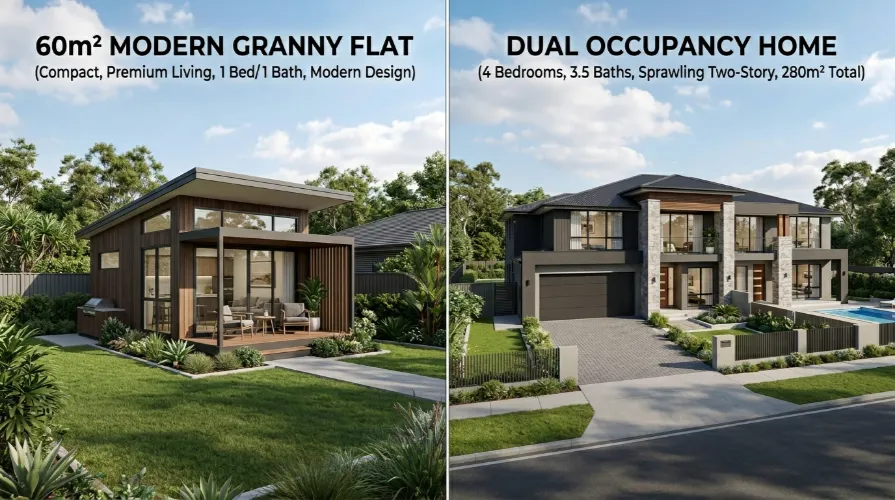
A granny flat in NSW can’t be more than 60 square metres in area. A dual occupancy may be of any size within standard council floor-space ratios. It acts like a house primary.
A comparison of dual occupancy vs duplex sydney rules shows that size and design flexibility differ. The granny flat should always remain legally subordinate to the main dwelling. Your rental demographic would be limited to singles, students, or couples.
A detached dual occupancy lets you design and construct two full-sized family homes (each with four bedrooms) on one block. Although the initial build cost is higher, a dual occupancy attracts a premium tenant capable of paying top dollar for their space and privacy. Ageing structures can occasionally be seen on a feature-rich plot of land. More parameters can well permit an upgradation. To this end, top-notch house knockdown-rebuild services in Sydney usually work well. Besides ensuring a clean slate, the plan is great for dual-family living.
Trust & Authority Block
Specialist Viewpoint.
It has the greatest potential for increasing property value in Sydney real estate today. If your lot meets the minimum allocation requirements for a duplex, the Torrens title split creates equity instantly. This is not the case for a standard dual occupancy. It alters your financial future completely. Jason Smith, Principal Builder, JS Construction, Sydney, 2026
Original Insight.
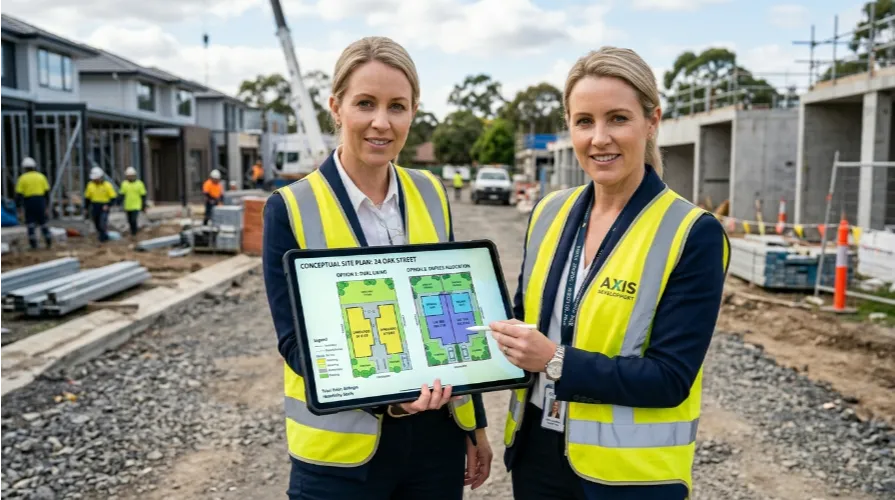
The Blacktown, Penrith and Canterbury-Bankstown councils in Sydney have simplified their Local Environmental Plans (LEPs) according to our on-the-ground building data from 2025 and 2026. Building a duplex on a 600 m² block in these areas now takes 30% less time via the Complying Development Code (CDC) than via a standard Development Application (DA). Through avoiding the council, our clients save on average $14,000 in holding costs and interest payments. To find out how effective these layout adjustments will be in practice, check out our deep Sydney home builder portfolio from previous dual-living jobs.
Frequently Asked Questions (FAQ)
Are dual occupancies able to be subdivided?
In most situations, a typical dual occupancy is not able to be subdivided as it does not comply with the minimum lot size or minimum frontage requirements imposed by local council LEPs for separate titles. When a block satisfies those particular dimensions, the development pathway usually becomes a formal duplex application.
What’s the minimum land size for duplexes in Sydney.
Minimum land size is dependent on the local government area. Some councils allow a lot size of a duplex development of 500m² to 600m² for an approval, whereas some councils don’t allow less than 700m² or a frontage width (around 12m-15m) for a Torrens title subdivision approval.
Is council consent or CDC necessary for a duplex?
A local council can approve a duplex through a standard Development Application (DA) or through the Low Rise Housing Diversity Code as a Complying Development Certificate (CDC). Although faster, the CDC pathway requires strict adherence to universal state-wide design codes. To prepare your property documents, read through our complete working with custom home builders guide so your investment timeline is protected. (22 words)
Are council rates for a duplex or dual-occupancy higher?
One related duplex development generates two titles and assessment notices and separate utility bills for each dwelling. The council rate notice for a dual occupancy will be a single notice with a scale for multi-unit services on a combined basis yielding lower ongoing tax overheads.
Conclusion
Choosing between dual-occupancy and duplex Sydney developments truly depends on your risk appetite, long-term wealth strategy and local council zoning restrictions. If you want the best rental yields with fewer capital layouts, a dual occupancy or dual living design is an option worth considering. A premium duplex build will give you separate titles, substantial equity creation and a flexible exit strategy. Do check your land’s zoning, frontage widths and minimum lot size before signing the building contract.